
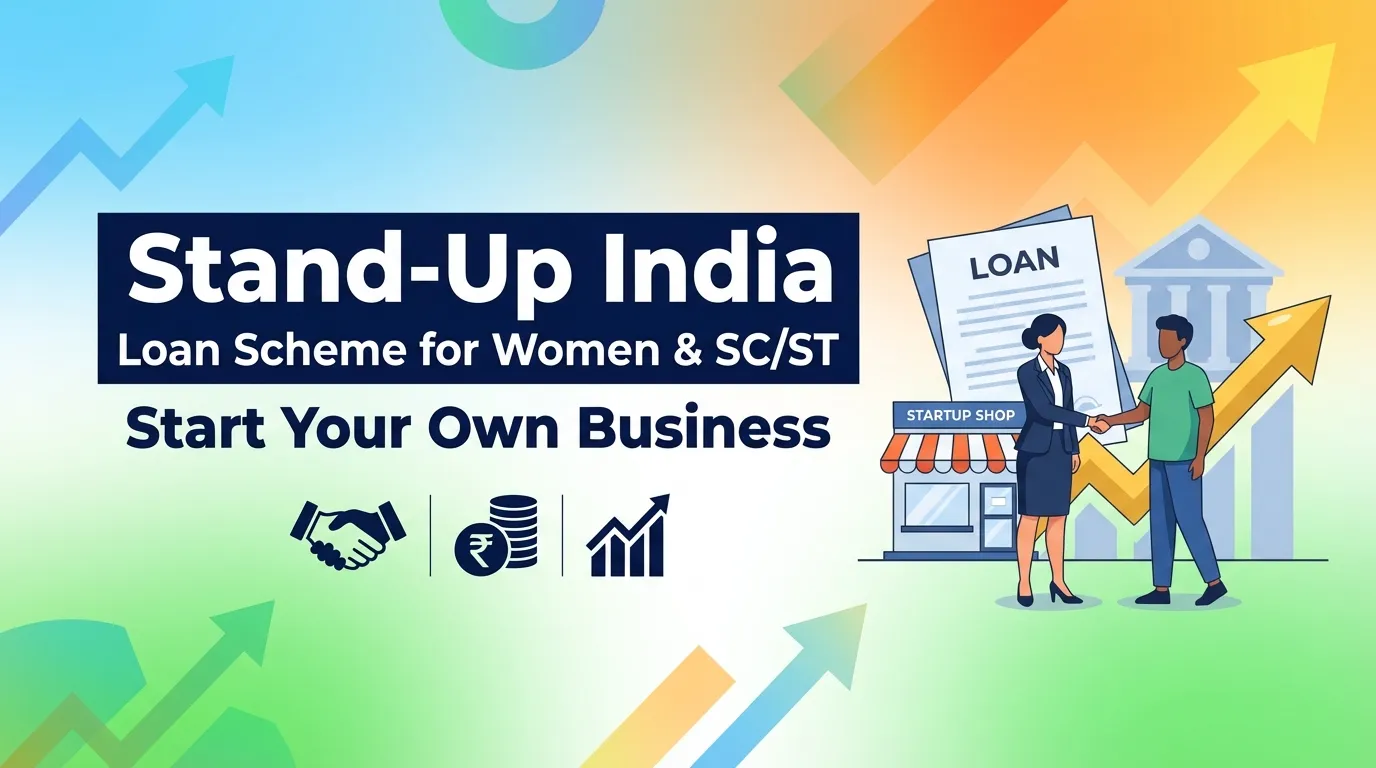
You know that sinking feeling when you walk into a bank with a dream but no collateral? I’ve seen it in my friend Priya’s eyes in 2016. A college graduate with a beauty parlor business plan, rejected because she had no land to mortgage, no husband to co-sign. “No collateral, no loan,” the banker said, as if reading from a script written centuries ago.
That same year, something arrived that felt less like a government scheme and more like a revolution disguised as a loan program. Stand-Up India. But let’s get one thing straight—this isn’t “just another women’s loan scheme.” This is the financial equivalent of a mic drop for three categories of people Indian banks traditionally ignored.
The Unlikely Trinity: Who Stand-Up India Actually Stands For
The genius of this scheme is in its targeting. It doesn’t say “all women” or “all poor people.” It’s surgically precise:
- SC/ST Entrepreneurs: First-time business owners from Scheduled Caste or Scheduled Tribe communities.
- Women Entrepreneurs: Any woman, from any community, starting her first enterprise.
And here’s the kicker: It’s for manufacturing, services, agri-allied activities, or trading. Basically, if you have a viable idea, they have the money. No “family business legacy” required. No “father’s references” needed.
The Numbers That Actually Matter: Beyond the 10 Lakh – 1 Crore Range
Yes, the loan amount is ₹10 lakh to ₹1 crore. But the real magic is in what comes with the money:
- The De-stigmatized Loan: For many first-generation SC/ST entrepreneurs, taking a loan carries social baggage. Stand-Up India packages it as “enterprise financing,” not “charity” or “debt.”
- The Hand-holding Promise: Each bank branch is supposed to facilitate at least one such loan. This means the branch manager isn’t just a loan officer; they’re your first business consultant.
- The Working Capital Safety Net: Up to 75% of the project cost can be financed. You’re not left scrambling for day-to-day expenses.
The Ground Reality: Where the Rubber Meets the (Very Bumpy) Road
Now, let’s talk about what doesn’t make it to the glossy brochures. My cousin, an aspiring Dalit entrepreneur in Lucknow, faced this:
The “First-Time Entrepreneur” Paradox: “They ask for business experience to get a loan for my first business,” he laughed bitterly. “How do I get experience without starting?”
The Collateral Conundrum: While the scheme is supposed to be collateral-free up to ₹10 lakh, many bankers still ask for “some security.” Old habits die hard.
The Knowledge Gap: The biggest hurdle isn’t money—it’s awareness. Most potential beneficiaries don’t know how to navigate the Stand-Up India Portal, prepare a project report, or even approach the designated branch.
But here’s where the story gets interesting. The scheme has evolved. Today, there’s a credit guarantee through CGTMSE, reducing the bank’s risk. There’s hand-holding through the Stand-Up India Portal, with sample project reports and application trackers. The RBI has told banks to be more proactive.
The Application Process: A Step-by-Step Survival Guide
If you’re applying, here’s what you really need to know:
- Start at the Portal: Go to www.standupmitra.in. Don’t just walk into a bank cold. This portal is your ammunition.
- Prepare Your “Why”: You need more than an idea. You need a story. How many jobs will you create? What problem are you solving? Bankers respond to vision, not just viability.
- The Documents Dance: Keep ready:
- Caste certificate (if applicable)
- Business plan/project report (use templates from the portal)
- Identity, address, and proof of residence
- Qualifications and experience certificates (even informal experience counts)
- Find Your Champion: Identify the Stand-Up India lead bank in your district. Seek out the designated officer. Build a relationship before dumping paperwork.
- The Follow-Up Game: Apply, then become politely persistent. Track online. Visit periodically. Your urgency signals your seriousness.
The Untold Stories: Where Stand-Up India Actually Worked
In a small town in Tamil Nadu, Shanti—a first-generation woman entrepreneur from the SC community—started a dairy processing unit with a ₹25 lakh loan. She now supplies to hotels in three districts, employs seven women from her community, and her daughter is studying engineering. “The loan didn’t just give me money,” she says. “It gave my community a new identity. We’re not ‘laborers’ anymore. We’re business owners.”
In Jaipur, Ramesh (name changed), an ST artisan, used a ₹15 lakh loan to modernize his traditional block-printing unit. He now exports to Germany. “The bank manager initially hesitated. Then he saw my samples, my designs. He became my biggest supporter.”
The Psychological Shift: More Than Money
This is Stand-Up India’s real victory. It created a new vocabulary in banking:
- From “Can you give us collateral?” to “Can you show us your vision?”
- From “What’s your family business?” to “What’s your business plan?”
- From “Why should we trust you?” to “How can we help you grow?”
It told millions of Priyas: “Your idea is valid. Your identity is not a liability. Your ambition is your biggest asset.”
The Road Ahead: What Stand-Up India 2.0 Needs
The scheme is good, but could be legendary with:
- Mentorship Networks: Pairing new entrepreneurs with successful ones.
- Market Linkages: Helping them find customers, not just capital.
- Simpler Compliance: Reducing the post-sanction paperwork trauma.
- Digital Empowerment: Teaching them to use UPI, manage GST, and embrace e-commerce.
Conclusion: The Standing-Up Part
Stand-Up India isn’t about getting a loan. It’s about rewriting an age-old script where banking was for the already privileged, where entrepreneurship required inheritance, where your last name mattered more than your big idea.
My friend Priya? She got her loan in 2018. Not from the first bank she approached. Not even the second. The third bank had a young, proactive manager who saw her determination. Today, she runs two beauty parlors, employs six women, and is training to become a certified makeup artist.
The last time we met, she said something I’ll never forget: “They didn’t just give me money. They gave me permission—permission to imagine bigger, to fail without shame, to stand up even when everyone expected me to sit down.”
And that’s the thing about standing up. Once you do it, you never really sit down again. You just find higher mountains to climb.